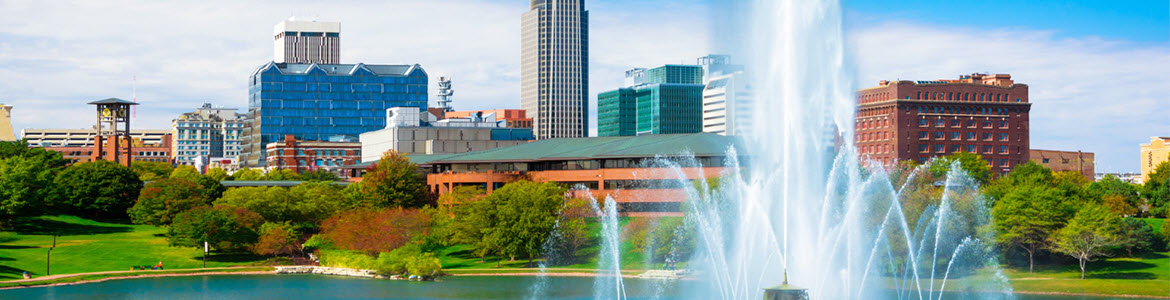
Berkshire Hathaway Inc. is a multinational conglomerate holding company headquartered in Omaha, Nebraska, USA.
According to the Forbes Global 2000 list and formula, Berkshire Hathaway is the third largest public company in the world. By revenue, it is the 9th largest conglomerate. It is also the largest financial service company by revenue.
Listed on the New York Stock Exchange, it is famous for having the most expensive share price in history. At the time of writing, a Class A share in Berkshire Hathaway Inc. cost 312,850 USD. The company chairman Warren Buffett has declared that there will not be a stock split, since he believes that a high share price attracts investors that are focused on long-term profits rather than short-term price fluctuations.
Examples of companies wholly owned by Berkshire Hathaway:
BNSF Railway
Dairy Queen
FlightSafety International
Fruit of the Loom
GEICO
Helzberg Diamonds
Long & Foster
Lubrizol
NetJets
Pampered Chef
Examples of companies where Berkshire Hathaway owns part of the company are Pilot Flying, United Airlines, Delta Air Lines, Southwest Airlines, American Airlines, Kraft Heinz Company, American Express, Wells Fargo, The Coca-Cola Company, Bank of America, and Apple.
Warren Buffet began investing in Berkshire Hathaway in the early 1960s and soon emerged as a company leader, a position he has kept since then. Today, he serves as both chairman and chief executive, with Omaha-born Charlie Munger a vice chairman.
Short facts about Berkshire Hathaway
Type
Public company
Traded as
NYSE: BRK.A (Class A)
NYSE: BRK.B (Class B)
There are also various CFD:s, binary options and other securities that you can trade with that are based on the stock of Berkshire Hathaway
Index inclusion
S&P 100 component (BRK.B)
S&P 500 component (BRK.B)
Headquarters
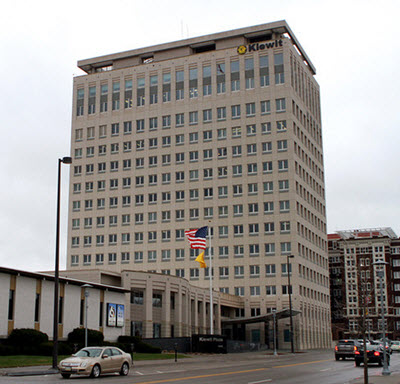
Kiewit Plaza, Omaha, Nebraska, USA
ISIN
US0846707026
Area served
Worldwide
Industry
Conglomerate
Products
Aerospace
Automotive
Consumer products
Diversified investments
Food processing
Internet
Media
Property & casualty insurance
Real estate
Restaurants
Sporting goods
Toys
Utilities
Revenue
US$250.13 billion (2017)
Operating income
US$20.90 billion (2017)
Net income
US$44.94 billion (2017)
Total assets
US$702.09 billion (2017)
Total equity
US$348.29 billion (2017)
Number of employees
Approximately 377,000 (2017)
The Kiewit Tower
Berkshire Hathaway’s corporate offices in Omaha are located in the Kiewit Tower on 3555 Farnam Street, at the corner of S 36th Street. The building is named after Peter Kiewit Sons’ (The Keiwit Corporation), a construction company which is also headquartered in the building.
Background
Berkshire Fine Spinning Associates
The Berkshire Cotton Manufacturing Company was established in Adams, Massachusetts in 1889. It’s first mill was the Berkshire Mill No. 1, built on Hoosac Street in 1895 by the locally prominent Plunkett family.
In 1839, Oliver Chace from Massachusetts founded a textile manufacturing company in Valley Falls, Rhode Island, and called it the Valley Falls Company. At this point, Chace already had plenty of experience within the field, having founded his first textile mill back in 1806.
In 1929, the Valley Falls Company merged with the Berkshire Cotton Manufacturing Company, creating the Berkshire Fine Spinning Associates.
The Hathaway Manufacturing Company
The Hathaway Manufacturing Company was founded by Horatio Hathaway in New Bedford, Massachusetts in 1888. The start up capital for the company was money that Horatio Hathaway had earned from whaling and the China Trade.
Berkshire Hathaway
Berkshire Hathway was formed in 1955, when Berkshire Fine Spinning Associates merged with the Hathaway Manufacturing Company.
After the merger, Berkshire Hathaway had 15 plants and over 12,000 plant workers. Before the end of the 1950s, seven of the plants had been closed and the workers laid off.
In the early 1960s, investor Warren Buffett noticed that the stock price for Berkshire Hathaway behaved in a predictable manner after each closing of a mill, and in 1962 he began buying stock in the company. Eventually, he realized that the U.S. textile business was in a decline, and when the company president Seabury Stanton made him an oral tender offer of $11 1⁄2 per share for the company to buy back the shares, Buffett accepted. Things turned sour a few weeks later when Buffet received the tender offer in writing, because now the price had been lowered to $11 3⁄8. This angered Buffett, who refused to sell at the lower price and instead started buying up more stock in the company, with the intention of gaining enough control to fire Stanton. Buffett eventually achieved this goal, but at the price of becoming the majority owner of a company in decline.
In 1967, Buffett decided to expand the company into the insurance industry and other investments, to make it less reliant on revenue from the struggling U.S. textile industry. The company’s first foray into the insurance field was the purchase of National Indemnity Company, an insurance company founded in Omaha in 1940 by Jack Debney Ringwalt. Today, it is Berkshire Hathaway’s oldest operating subsidiary.
In 1985, Berkshire Hathaway’s last textile operations were shut down.
In 2010, Buffett said that purchasing Berkshire Hathaway was the largest investment mistake he ever made. He bought a controlling share in the company to get back at Stanton, and it would have been more profitable to invest the money directly in the insurance industry instead.
Timeline
Berkshire Hathaway: The Evolution of a Conglomerate
From struggling New England textile mill to a trillion-dollar compounding powerhouse
1839 & 1955
Textile Roots & The Merger
Origins
Oliver Chace founds the Valley Falls Company in 1839. Over a century later, it merges with the Berkshire Fine Spinning Associates and Hathaway Manufacturing Company in 1955 to create Berkshire Hathaway Inc., a sprawling New England cotton-textile producer.
Warren Buffett notices a pattern of share repurchases and begins buying shares at $7.50 through Buffett Partnership Ltd. After a dispute over a tender offer with CEO Seabury Stanton, Buffett buys control in May 1965 and takes the helm.
March 1967
National Indemnity & The Insurance “Float” Model
Pivotal Shift
Berkshire acquires National Indemnity Company and National Fire & Marine Insurance for $8.6 million. This marks the foundational pivot away from dying textile mills toward using low-cost insurance premiums (“the float”) to fund long-term equity compounding.
January 1972
See’s Candies: The Economic Moat Revelation
Charlie Munger’s Influence
At Charlie Munger’s urging, Berkshire acquires See’s Candies for $25 million (paying 3x net tangible assets). The acquisition transforms Buffett’s philosophy from cigar-butt deep value to buying “wonderful businesses at fair prices” with immense pricing power.
1978
Charlie Munger Officially Named Vice Chairman
Leadership
Diversified Retailing merges into Berkshire Hathaway, and Charlie Munger formally joins as Vice Chairman. The Buffett-Munger partnership institutionalizes decentralized management, multidisciplinary mental models, and disciplined capital allocation.
July 1985
Closure of the Original Textile Operations
End of an Era
Facing irreversible foreign competition and low capital returns, Buffett shuts down the historic New Bedford textile mills after two decades of subsidizing them, preserving the corporate shell solely as an investment holding company.
1988
Accumulating Coca-Cola (The Signature Trade)
Core Equities
Following the 1987 stock market crash, Berkshire pours over $1 billion into The Coca-Cola Company, acquiring roughly 7% of the company. It becomes Berkshire’s flagship equity holding and one of Wall Street’s most famous dividend-compounding investments.
1996
Class B Shares (BRK.B) & GEICO Full Buyout
Retail Access
Berkshire acquires the remaining 49% of GEICO, making it a wholly owned subsidiary. To thwart unit investment trusts from repackaging high-priced Class A shares, Berkshire issues Class B shares (initially at 1/30th the price of Class A), broadening retail investor ownership.
December 1998
Acquisition of General Re
Mega Reinsurance
Berkshire issues equity to acquire global reinsurance giant General Re for $22 billion. The deal dramatically expands Berkshire’s total investable insurance float from $7 billion to over $21 billion almost overnight.
September 2008
Great Financial Crisis Capital Infusions
Lender of Last Resort
Acting as the market’s private backstop, Berkshire deploys cash into high-yielding preferred stock and equity warrants with Goldman Sachs ($5B), General Electric ($3B), and later Bank of America ($5B), reaping tens of billions in crisis profits.
Berkshire completes the $26 billion acquisition of Burlington Northern Santa Fe (BNSF), betting on American freight infrastructure. Concurrently, Class B shares execute a 50-for-1 split, and Berkshire Hathaway formally joins the S&P 500 index.
May 2016
The Apple Bet Begins
Modern Tech Giant
Led by portfolio managers Todd Combs and Ted Weschler and championed by Buffett, Berkshire initiates an initial position in Apple Inc. Over subsequent years, the position expands into a massive stake that generates over $100 billion in unrealized capital gains.
28 November 2023
Passing of Charlie Munger (Age 99)
Historic Loss
Vice Chairman Charlie Munger passes away just 34 days shy of his 100th birthday. Buffett honors Munger in the annual shareholder letter as the “architect of Berkshire Hathaway” who engineered the blueprint for its modern structure.
2024 – Present
$1 Trillion Valuation & Succession Clarity
Trillion Club
Berkshire becomes the first non-tech American corporation to eclipse a $1 trillion market capitalization. Greg Abel (Non-Insurance operations) and Ajit Jain (Insurance) stand designated as the operational leadership carrying Berkshire’s governance and fortress balance sheet into the future.
The Compounding Engine: From 1965 to present, Berkshire Hathaway delivered an annualized return exceeding 19.8% (outpacing the S&P 500’s ~10.2%), driven by its unique dual engine: an insurance float exceeding $160 billion and wholly owned utility, rail, and consumer subsidiaries.